

Is Expensive Coffee Worth the Cost? A Practical Guide
Last Updated: November 15, 2026
Quick Summary
Expensive coffee is worth the cost when the premium buys freshness, careful processing, and a roast level matched to your brew method. Judge it by cost per cup, not cost per bag: a $24.99 bag works out to roughly $1.32 to $1.67 per serving. Past a certain point, higher prices buy rarity and story more than flavor.
- Divide the bag price by the cups it actually produces to get your true cost per cup.
- A 12-ounce bag at $24.99 yields about 15 pour-over servings at roughly $1.67 each.
- Fix freshness first: a modest bag roasted last week usually beats a costly bag roasted months ago.
- Buy a 4-ounce sample size before committing to a full bag from a new roaster.
- A cheaper bag is adequate when you brew large drip batches or add milk and sweetener.
Table of Contents
- The Real Question Behind Is Expensive Coffee Worth the Cost
- Why Is Specialty Coffee So Expensive?
- Does Expensive Coffee Taste Better?
- Is Expensive Coffee Worth the Cost per Pound?
- Budget vs. Premium Coffee: How the Tiers Compare
- Roast Freshness, Processing, and What Price Does Not Buy
- A Buying Framework by Budget and Taste Preference
- Building Your Own Side-by-Side Tasting at Home
- Frequently Asked Questions
The Real Question Behind Is Expensive Coffee Worth the Cost
Most coffee drinkers do not actually want a philosophy lecture on price. They want to know whether the bag in their hand delivers something the cheaper bag down the aisle does not. At Oak & Origin Coffee Co., we hear a version of this question constantly: is expensive coffee worth the cost, or is the premium just packaging and a good story?
The honest answer is that it depends on what you are buying and how you brew it. A $24.99 bag of small-batch beans used for a single daily pour-over lands near a dollar or so per cup. The same bag pulled as espresso for a household of three finishes in a week. Price per bag tells you almost nothing. Price per cup, adjusted for how you actually drink it, tells you everything.
What This Guide Compares
We break the question into four parts: where the money goes, whether the cup actually tastes better, how cost per serving changes with brew method, and how to buy well at any budget. No hype, no invented numbers, just the arithmetic and the tasting logic that should drive the decision.
Why Is Specialty Coffee So Expensive?
Specialty coffee costs more because more hands, more care, and more risk sit between the seed and your grinder. Specialty coffee is picked selectively, sorted, processed with intention, and roasted to order in small batches.
From Farm to Cup: Where the Money Goes
A single bag pays for a long chain: green coffee bought from the producer or cooperative, labor at the mill, export logistics, import fees, warehousing, roasting, packaging, and the roaster's own margin. When a roaster publishes sourcing details, you can see which links in that chain they are strengthening. Readers who want to check a roaster's claims can learn to verify coffee supply chain transparency rather than taking a label at its word.
Rarity, Origin, and Growing Conditions
Altitude, soil, shade, and harvest timing all shape what a bean can become. Volcanic loam and cool elevations, like those behind our Bali Blue Moon, shape the coffee's character. Scarcity plays a role too: a small high-elevation lot simply yields fewer bags than a commodity harvest.
Does Expensive Coffee Taste Better?
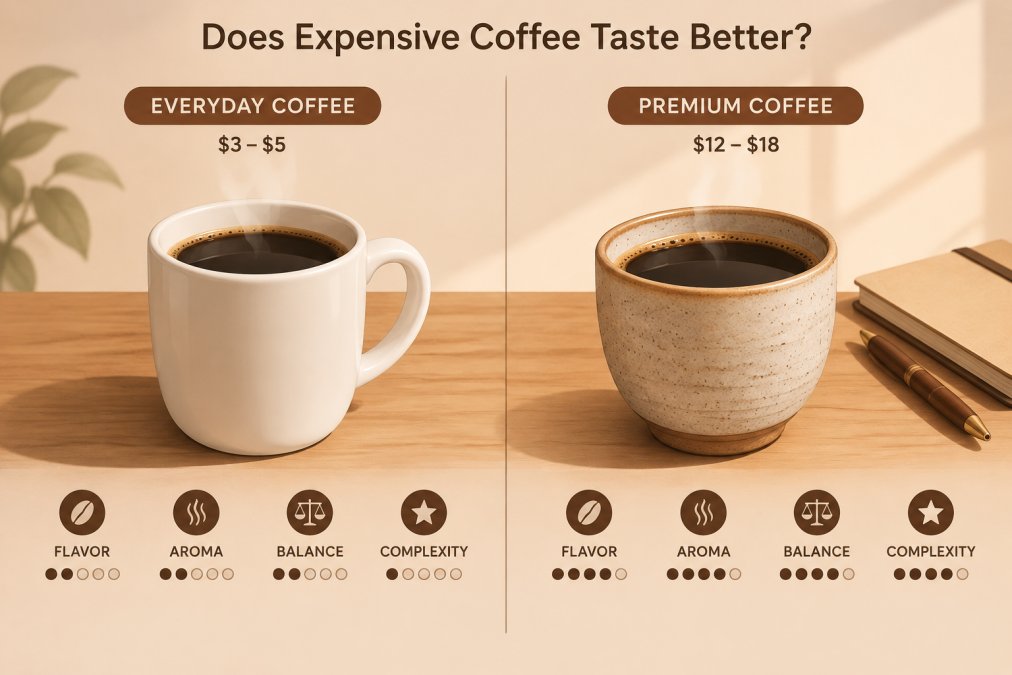
Expensive coffee tastes better only when the premium buys freshness, careful processing, and a roast level matched to the bean. Past a certain point, higher prices buy rarity and story more than they buy flavor. This is the diminishing-returns line every buyer should understand.
What a Side-by-Side Tasting Reveals
A blind side-by-side is the only honest test. Brew a grocery-store bag and a fresh specialty bag the same way, same grind, same water, same dose, and taste them without knowing which is which. Most people notice freshness first, then sweetness and clarity. A common mistake is comparing coffees brewed differently and calling it a price verdict.
Is Expensive Coffee Worth the Cost per Pound?
Expensive coffee is worth the cost per pound when the bag is fresh and you drink it within a few weeks. Pound price is a shelf metric, not a drinking metric. The number that actually settles the question is cost per cup, and that number moves a lot depending on how you brew.
Cost per Cup vs. Cost per Bag
Divide the bag price by the number of cups it actually produces. A $24.99 bag used for one pour-over a day stretches across many mornings. The same bag pulled as double espressos for a busy household disappears fast, and the per-cup figure rises accordingly. Track your real consumption for a week before judging any bag expensive.
Value Adjusted for Brew Method and Serving Size
Brew method changes the math more than most buyers expect.
Here is the same $24.99, 12-ounce bag (about 340 grams) run through four common serving styles. These are arithmetic examples, not promises about any specific bag:
| How you drink it | Approx. coffee per serving | Servings per 12-oz bag | Approx. cost per serving |
|---|---|---|---|
| 12-oz drip cup | ~20 g | ~17 | ~$1.47 |
| 12-oz pour-over | ~22 g | ~15 | ~$1.67 |
| Double espresso | ~18 g | ~19 | ~$1.32 |
| 12-oz latte (2 shots) | ~18 g | ~19 | ~$1.32 plus milk |
Servings per 12-oz bag
A few patterns fall out of that table. Drip and pour-over look similar per cup because the dose is similar; the difference is mostly ritual and time, not coffee cost. Espresso looks cheap per shot but disappears quickly in a household that pulls several a day.
Watch out: comparing a premium bag's per-cup cost against a grocery bag's per-bag price is the most common math error. Compare per cup to per cup, using your real dose.
If pour-over is your method, our step-by-step pour over guide shows how dose and grind size shift your cost per cup before you commit to a pricier bag.
Budget vs. Premium Coffee: How the Tiers Compare
The tiers differ less in caffeine than in freshness, traceability, and how much character survives the roast. Here is the practical split.
| Tier | Typical Price Signal | Freshness | Flavor Character | Best For |
|---|---|---|---|---|
| Grocery-store coffee | Lowest | Often months old | Consistent, muted | High-volume drip, office pots |
| Mid-tier bagged coffee | Moderate | Variable | Some origin character | Everyday drinkers testing the waters |
| Small-batch specialty | Higher | Roasted to order | Clear, distinct origin notes | Daily ritual drinkers, tasters |
Budget tier pros: low cost per cup, widely available. Cons: stale roast dates, vague origin. Premium tier pros: fresh roast, traceable farms, distinct flavor. Cons: higher upfront cost, shorter peak window.
A Decision Framework: When to Spend More, and When Not To
Price alone is a weak signal. The better question is which variable you are actually trying to improve. Use this order of priority:
- Fix freshness first. A modest bag roasted last week usually beats a costly bag roasted months ago. If you can only change one thing, change the roast date.
- Match roast level to brew method. A light roast that shines as pour-over can taste thin and sour in a drip machine that brews cool; a darker roast can turn bitter in espresso. Spend more only after the roast level fits your gear.
- Choose flavor direction before price. Decide whether you want chocolate and caramel or citrus and floral, then buy within that direction. A rare high-acidity lot is not better for a drinker who loves a smooth medium roast, it is just different.
- Buy small before buying big. A sample or 4-ounce size lets you test a roaster's style before committing to a full bag.
- Check whether origin and producer are named. Named farms and lots are a sign of traceability; vague "premium blend" language is not.
When a Cheaper Bag Is Adequate
A lower-priced bag is a reasonable choice when you brew large drip batches for a crowd, when you add milk and sweetener that mask subtle origin notes, when you drink coffee mainly for caffeine, or when you go through a bag fast enough that staleness never becomes the issue. In those cases the premium is paying for nuance you will not taste.
When the Premium Is Worth It
The premium earns its keep when you brew small and dose carefully, when you drink black or with little milk, when you want to taste a specific origin or processing method, and when you will finish the bag inside its peak window. That is the narrow set of conditions where the extra spend shows up in the cup rather than on the label.
If you want concrete options inside your budget, our list of small batch coffee beans to buy online pairs each pick with a flavor profile. For a deeper dive into specific lots, see our guide to the best tasting single origin coffee beans.
Best for: daily ritual drinkers who want traceable, fresh-roasted beans. Skip if: you need the lowest possible cost per cup and drink coffee purely for caffeine.
Roast Freshness, Processing, and What Price Does Not Buy
Check the roast date, not just the price tag. What price cannot buy is your own palate. If you love a smooth medium roast, a rare high-acidity lot is not better for you, just different.
A Buying Framework by Budget and Taste Preference
Use this checklist before you spend:
- Set a per-cup budget, not a per-bag budget
- Confirm the roast date is recent
- Match roast level to your brew method
- Choose flavor direction first: chocolate and caramel, or citrus and floral
- Buy a small size before committing to a full bag
- Check whether origin and producer are named
If you want concrete options inside your budget, our list of small batch coffee beans to buy online pairs each pick with a flavor profile. For a deeper dive into specific lots, see our guide to the best tasting single origin coffee beans.
Best for: daily ritual drinkers who want traceable, fresh-roasted beans. Skip if: you need the lowest possible cost per cup and drink coffee purely for caffeine.
Building Your Own Side-by-Side Tasting at Home
Run the test yourself and stop guessing. Brew two coffees identically, label the cups A and B, and taste blind. Note aroma, acidity, body, and sweetness. Then reveal. A sample pack makes this easy without buying full bags, and our Discovery Pack includes flagship coffees.
The real challenge is not deciding whether premium coffee is worth it in the abstract. It is finding a roaster whose freshness, sourcing, and roast levels match how you actually brew. Oak & Origin Coffee Co. roasts small batches to order from ethically sourced beans. Start with a sample pack, taste across roast levels, and let your own palate settle the price question. Get started with Oak & Origin Coffee Co. and build a morning ritual worth the cost per cup.
Frequently Asked Questions
Is expensive coffee actually worth the money?
It depends on how you brew and how often you drink it. A $24.99 bag that yields roughly 25 to 30 cups works out to about $0.85 to $1.00 per cup, which is still less than most cafe drinks. Expensive coffee is worth it when you drink it black or with minimal milk, brew it yourself, and value traceable origin and roast freshness. If you load your cup with syrup and milk, the flavor differences narrow and the premium is harder to justify.
Does more expensive coffee taste better?
Not automatically, but the odds improve. Higher prices usually reflect hand-picking, small-lot processing, and fresher roasting, all of which protect sweetness and clarity. The gap shrinks between two fresh specialty coffees at different prices, so taste before assuming the pricier bag wins.
What makes some coffee beans more expensive than others?
Labor, altitude, scarcity, and processing drive most of the difference. Hand-picked ripe cherries at high elevation cost more to produce than machine-harvested strip picking. Washed and experimental processing methods add time and risk. Small-lot auctions and single-origin traceability add further premiums. Shipping, roasting in small batches, and packaging also raise the final price compared with commodity grocery-store coffee.
Is single-origin coffee worth the extra cost?
If you want to taste a specific place, yes. A single origin like a medium-roast Peru highlights one farm collective's character, such as salted caramel and citrus, without other beans masking it. Blends cost less to produce consistently and suit espresso and milk drinks well. Try a sample pack first so you can compare a single origin against a blend before committing to a full bag.
