

How to Store Whole Bean Coffee After Opening
Quick Summary
Keep whole bean coffee in a cool, dry, dark cupboard, away from heat, light and moisture. Fold and clip the original bag after each use, or move the beans to an opaque airtight container if you will finish them in two to four weeks. Freeze portions you will not use within a few weeks.
- Oxygen, heat, light and moisture are the four main causes of staleness in opened beans.
- The fridge is usually a poor choice because beans absorb odors and moisture from other foods.
- Original valve bags are best finished within two to three weeks of opening.
- Airtight opaque containers keep beans at peak flavor for about three to four weeks after opening.
- Freeze beans in small airtight portions and thaw each one sealed before opening.
Table of Contents
- Why Opened Whole Bean Coffee Goes Stale
- Original Bag or Separate Container: Which to Use
- Step 1: Choose the Right Spot in Your Kitchen
- Step 2: Store Whole Bean Coffee in the Fridge or Freezer
- Step 3: Freeze and Thaw Whole Bean Coffee Correctly
- How Long Whole Bean Coffee Stays Fresh After Opening
- Keeping Whole Bean Coffee Fresh for Months at a Time
- Choose Your Next Bag of Beans and Store It Right From Day One
- Frequently Asked Questions
Why Opened Whole Bean Coffee Goes Stale
Last Updated: November 14, 2026
Once you open a bag of whole bean coffee, the clock starts ticking. Oxygen, heat, light, and moisture all work to strip away the oils and aromas that make a cup taste good. A few simple habits can keep your beans tasting bright for much longer.
Whole bean coffee is a natural product. Its flavor lives in fragile oils that break down when they meet air. Grinding exposes even more surface area, so whole beans hold their flavor longer than pre-ground coffee does. That is why storing the beans themselves, and grinding just before you brew, makes such a big difference.
Here is what usually causes staleness:
- Oxygen: It oxidizes the oils and flattens the flavor.
- Heat: It speeds up that oxidation.
- Light: It can break down delicate aromatics.
- Moisture: It can make beans clump and taste dull.
Keep these four enemies in mind, and the rest of this guide will make sense.
Original Bag or Separate Container: Which to Use
Most guides tell you the original bag is fine and an airtight container is better, then leave you to pick. Here is the decision rule that resolves it. Judge your bag on three features, then match the choice to how long the beans will sit before you finish them.
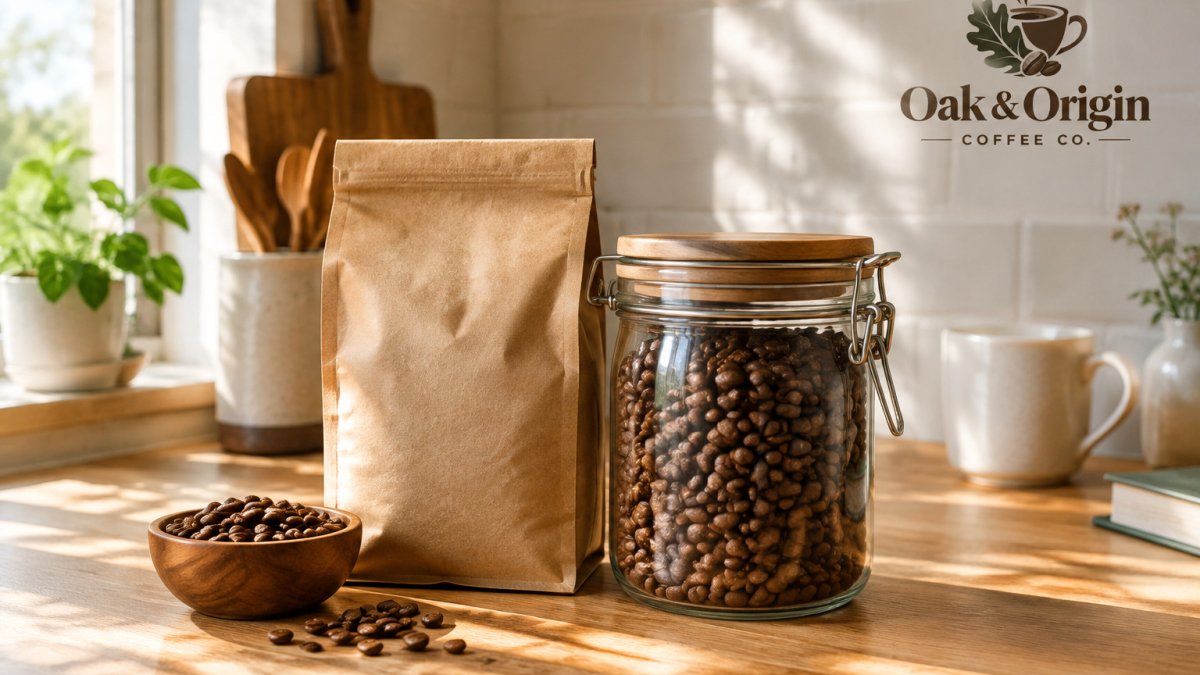
Score your bag first.
- One-way valve: A valve lets carbon dioxide escape without letting oxygen in. If your bag has one, it is doing real work for the first week or two after roast.
- Resealable closure: A zip top, tin tie, or fold-over with a clip keeps air exchange low between scoops. A bag you tear open and cannot close is a poor long-term home.
- Opaque barrier: Foil-lined or metallized bags block light. Kraft paper or clear windows do not.
Then apply the rule:
- Finishing the bag in two weeks or less, with a valve and a working reseal: Keep the beans in the original bag. Fold the top down, press out excess air, and clip or zip it closed after every scoop. The valve and barrier are already engineered for coffee, and transferring beans only adds a step.
- Finishing in two to four weeks, or the bag is torn, clear, or paper: Move the beans to an opaque airtight container. A canister with a rubber gasket or a locking clamp lid keeps oxygen exchange lower than a folded bag, and the rigid walls block light.
- Buying in bulk or storing longer than a month: Skip the counter container and portion into the freezer (see the freezing section below). No pantry container holds peak flavor for months.
What to look for in a container. Opaque walls, a gasket seal, and a size that matches your typical purchase. A container that is much larger than the amount of beans inside holds more oxygen against the beans. Vacuum canisters pull air out and can extend the window, but they cost more and add a pumping step to every scoop. Valve canisters let gas escape while limiting incoming air, which suits slow drinkers. A plain glass jar with a rubber ring works if you keep it in a dark cupboard; a clear jar on a sunny counter does not.
Watch out: Do not pour new beans on top of old ones in the same container. The older beans transfer stale oils and aromas, and you lose track of which beans are actually fresh. Finish or freeze one batch before opening the next.
Step 1: Choose the Right Spot in Your Kitchen
Your storage spot matters as much as your container. The goal is a place that stays cool, dry, and dark.
- Pick a cupboard or pantry. A spot away from the stove, dishwasher, and oven is ideal.
- Avoid the window ledge. Sunlight warms beans and can fade their flavor.
- Skip the fridge door. Every time you open it, the temperature swings.
- Keep it dry. Steam from the sink or kettle is a common source of moisture.
Room temperature in a dark cupboard is the best option for most households. It keeps beans stable while you drink through them.
Step 2: Store Whole Bean Coffee in the Fridge or Freezer
You may have heard that coffee belongs in the fridge. In most cases, the fridge is not the best home for it. Coffee beans can absorb odors and moisture from other foods, and repeated temperature changes can cause condensation.
The freezer can work well, but only for beans you won't use within a few weeks. Store them in small, airtight portions so you thaw only what you need. Never keep a freezer bag open and return it to the freezer again and again.
Step 3: Freeze and Thaw Whole Bean Coffee Correctly
Freezing is a smart way to save beans you won't finish soon. Follow these steps to protect the flavor.
- Divide the beans. Portion them into weekly or two-week amounts.
- Remove the air. Use a vacuum-seal bag or press out as much air as you can.
- Label each bag. Write the roast date and the freeze date.
- Freeze them flat. Flat bags freeze faster and take up less room.
- Thaw before opening. Move one portion to the counter and let it reach room temperature while still sealed.
- Grind after thawing. Do not grind frozen beans, and do not refreeze thawed beans.
Thawing with the bag sealed keeps condensation off the beans. Once a portion is thawed, use it within a few days.
How Long Whole Bean Coffee Stays Fresh After Opening
Freshness has two clocks: the roast date and the open date. Most guides only track the open date. Track both and you can predict what a bag will taste like before you brew it.
The roast-date clock. Whole beans are at their most expressive roughly 3 to 14 days after roast, once they have degassed enough to brew evenly. After that, flavor fades gradually rather than falling off a cliff. A common pattern is peak aroma and sweetness in the first two to three weeks post-roast, solid drinking quality through about four to six weeks, and noticeably flatter cups beyond that. Darker roasts tend to fade faster than lighter roasts because their surface oils are more exposed to oxygen.
The open-date clock. Opening the bag starts the real decline. Once oxygen hits the beans, the oils begin to oxidize. Here is what to expect by storage method, counted from the day you open the bag:
| Storage Method | Peak Flavor | Still Good | Notes |
|---|---|---|---|
| Original valve bag, folded and clipped | 2 to 3 weeks | Up to about 4 weeks | Best for bags you finish quickly |
| Airtight opaque container, dark cupboard | 3 to 4 weeks | Up to about 6 weeks | Rigid seal limits air exchange |
| Vacuum canister | 4 to 6 weeks | Up to about 8 weeks | Extra step per scoop |
| Frozen in sealed portions | 6 months or more | Up to a year | Thaw one portion at a time |
Treat these as ranges, not guarantees. A bag opened at day 30 post-roast has less runway than one opened at day 5, even under identical storage.
How to tell without guessing. Freshness loss shows up in the senses before it shows up anywhere else. Smell the bag: fresh beans release a clear, sweet aroma when you open it, while stale beans smell muted, dusty, or papery. Rub a bean between your fingers: fresh beans feel oily and dense, stale ones feel dry and light. Taste a cup: flat flavor, a hollow mid-palate, and a lack of sweetness are the usual signs, and stale beans often brew with more bitterness because the brighter acids have faded. None of these mean the coffee is unsafe; they mean it has passed its peak.
Watch out: Do not judge freshness by the printed date alone. A 'best by' date is not a roast date, and a bag with no roast date gives you no way to know how much of the clock has already run. Look for a roast date on the bag, and note the open date so you can track both clocks.
Keeping Whole Bean Coffee Fresh for Months at a Time
If you want to keep beans for the long haul, freezing is your best bet. Vacuum sealing removes the most oxygen, which gives you the longest protection.
Some people also use specialty canisters with a one-way valve. These let carbon dioxide escape while keeping air out. They are a good option for households that go through beans slowly and want to keep the flavor steady over time.
Good habits matter more than fancy gear. Keep beans cool, dry, and dark, and open only what you plan to use.
Choose Your Next Bag of Beans and Store It Right From Day One
Storage works best when you start with fresh beans. Look for a roast date on the bag, and choose a size you can finish in a few weeks. Oak & Origin Coffee Co. offers small-batch coffee that is roasted to order, so you start with fresh beans.
If you're ready to start, explore our Blonde for a bright, light cup, or read our guide on 7 Small Batch Coffee Beans to Buy Online. You can also see Where to Buy Fresh Roasted Coffee Beans Online to find the right bag for your next order.
BUTTON: Shop Fresh Whole Beans CARD_TITLE: Ready for fresher coffee? CARD_TEXT: Oak & Origin Coffee Co. roasts small batches to order, so your beans arrive ready to store well.
Frequently Asked Questions
What is the best way to store whole bean coffee to keep it fresh?
Keep whole bean coffee in an airtight, opaque container in a cool, dark cupboard away from the stove, dishwasher and sunlight. Press out as much air as you can before sealing. A container with a one-way valve helps release the carbon dioxide that beans keep producing after roasting while keeping oxygen out. Grind only the amount you need right before brewing, since grinding exposes far more surface area to air and speeds up staling.
How long does whole bean coffee stay fresh after opening?
Whole bean coffee is at its best for roughly two to four weeks after you open the bag, when stored properly at room temperature. Beans stored in an airtight container away from heat and light hold their flavor longer than beans left in a loosely folded bag. Beans roasted recently and stored well may taste good for a bit longer, but the flavor gradually fades as oxygen works on the oils in the beans. Buying in quantities you can finish within a few weeks keeps every cup tasting its best.
Should you store coffee beans in the fridge or freezer?
The freezer is a better option than the fridge for long-term storage, but only if you portion the beans and seal them well. Fridges are humid and frequently opened, which exposes beans to moisture and odors that dull flavor. A freezer can extend freshness for months when beans are divided into small airtight portions, each used once after thawing. Once thawed, do not refreeze the beans, and let them come to room temperature before opening the bag to avoid condensation.
Can you freeze whole bean coffee after opening?
Yes, you can freeze whole bean coffee after opening if you do it properly. Divide the beans into single-use portions, place each in an airtight, freezer-safe bag with as little air inside as possible, and label the date. Take out one portion at a time and let it thaw at room temperature for about an hour before opening the bag, so condensation does not form on the beans. Grind the beans straight from the frozen or thawed state and avoid refreezing any leftovers.
