

How to Make Iced Tea From Loose Leaf Tea at Home
Table of Contents
- What You Need to Make Loose Leaf Iced Tea
- Loose Leaf Iced Tea Ratio: How Much Tea for Your Water
- Hot Brew or Cold Brew: Which Method Fits Your Day
- How to Hot Brew Loose Leaf Tea Over Ice
- Cold Brew Loose Leaf Tea Step by Step
- Choosing the Best Loose Leaf Tea for Iced Tea
- Making a Loose Leaf Iced Tea Pitcher and Storing It Safely
- Start Your First Batch Tomorrow Morning
- Frequently Asked Questions
What You Need to Make Loose Leaf Iced Tea
Last Updated: November 8, 2026
The process for making iced tea from loose leaf tea is simpler than most people expect. You need only a few tools and good water. Learning how to make iced tea from loose leaf tea at home takes about 10 minutes of hands-on work for a hot-brew batch, or a few hours of patient steeping for a cold-brew batch.
Start with a few basics:
- Loose leaf tea: Black tea holds up best over ice. Green, white, and herbal blends work well too.
- Fresh, filtered water: Taste matters more than most people think.
- A heat-safe pitcher or glass carafe: Glass is a good choice because it does not hold onto flavors.
- A strainer or infuser: A fine mesh strainer works well, and a French press or tea infuser works even better.
- Ice: Use ice cubes or a bag of crushed ice.
- A kitchen scale or measuring spoons: Scales give the most consistent results.
- Optional sweetener: Simple syrup, honey, or agave all dissolve well in cold tea.
Loose leaf tea is most flavorful when it is fresh and stored away from light and moisture.
Loose Leaf Iced Tea Ratio: How Much Tea for Your Water
The right ratio for loose leaf iced tea is roughly 1 teaspoon of tea for every 8 ounces of water. For a full 2-quart pitcher, that means about 8 teaspoons of loose leaf tea.
Stronger tea tastes bold but can turn bitter, especially when brewed hot. Weaker tea tastes thin and gets watery once you add ice. Measure carefully and taste as you go.
Here is a quick guide to get you started:
| Batch Size | Loose Leaf Tea | Water | Best For |
|---|---|---|---|
| 1 cup (8 oz) | 1 teaspoon | 8 oz | A single glass |
| 1 quart (32 oz) | 4 teaspoons | 32 oz | Two to three servings |
| 2 quarts (64 oz) | 8 teaspoons | 64 oz | A full pitcher |
Loose Leaf Tea
Adjust these numbers to match your taste. Once you find a ratio you like, write it down so you can repeat it.
Hot Brew or Cold Brew: Which Method Fits Your Day
Hot brew and cold brew produce genuinely different iced tea from the same leaves, and the right choice depends on your schedule, the tea type, and how you plan to serve it. Expert brewing tips cover how grind size, water temperature, and steep time shape flavor, so you can get the most from either method at home. Use this comparison to decide before you measure anything.
| Factor | Hot Brew | Cold Brew |
|---|---|---|
| Hands-on time | About 10 minutes | About 5 minutes |
| Total time to drink | 20 to 30 minutes (including chilling) | 8 to 12 hours |
| Water temperature | 160°F to 212°F depending on tea type | 35°F to 40°F (refrigerator temperature) |
| Flavor profile | Bolder, more aromatic, more astringent | Smoother, sweeter, lower bitterness |
| Strength control | Easy to over-steep; strain promptly | Forgiving; hard to over-steep |
| Best tea types | Black, oolong, pu-erh, strong herbal blends | Green, white, light oolong, fruity herbal blends |
| Best for | Same-day drinking, entertaining, strong tea lovers | Planning ahead, delicate teas, low-bitterness preferences |
| Main risk | Bitterness from over-steeping or dilution from ice | Flat or weak flavor if under-steeped or under-dosed |
Choose hot brew when: you want iced tea within half an hour, you are brewing black tea or a robust herbal blend, or you want the aromatic top notes that heat extracts. Hot brew is also the better choice when you plan to sweeten, because sugar and honey dissolve readily in warm liquid.
Choose cold brew when: you can start the night before, you are brewing green or white tea, or you want a low-bitterness cup without watching a timer. Cold brew is also more forgiving for beginners because the extraction is slow and gradual.
Choose a hybrid when: you want speed without dilution. Brew a hot concentrate at double strength, then chill it quickly in an ice bath and dilute with cold water rather than melting ice. This gives you hot-brew flavor with cold-brew control over final strength.
A common pattern is to hot brew black tea for same-day pitchers and cold brew green or white tea overnight for a smoother everyday glass. Whichever method you choose, the basic sequence stays the same: measure, steep, strain, chill, and serve.
How to Hot Brew Loose Leaf Tea Over Ice
Hot brewing is a good choice when you need iced tea fast. Follow these steps to learn how to make iced tea from loose leaf tea the quick way:
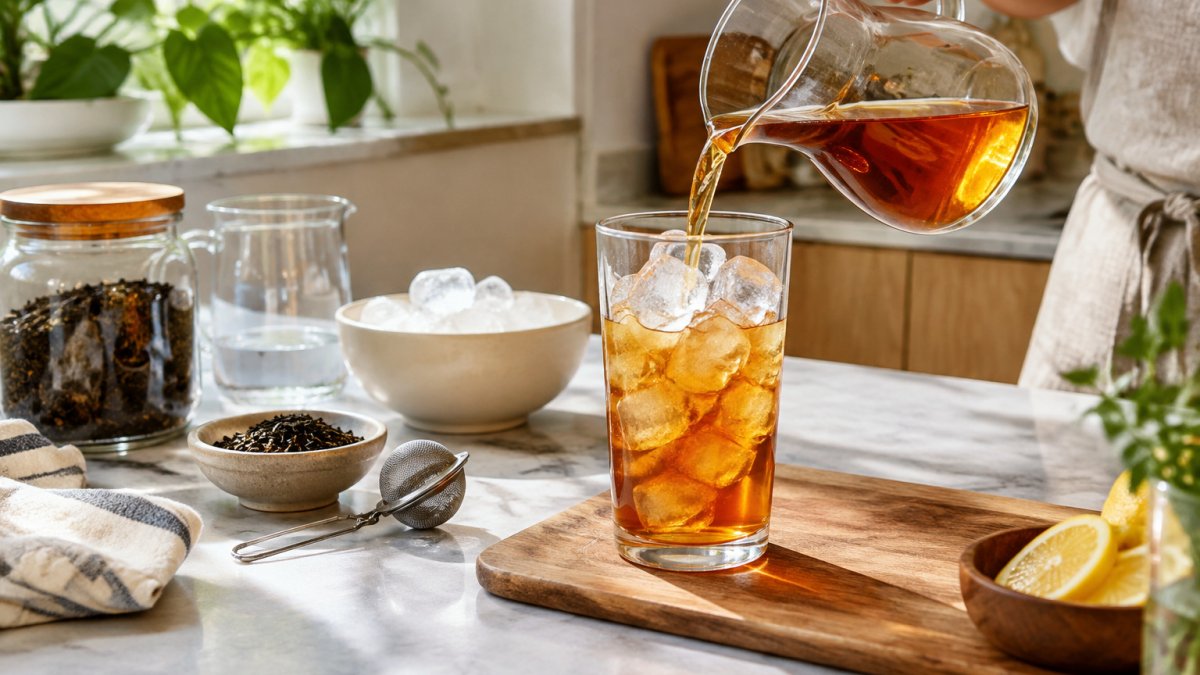
- Heat your water. Bring fresh water to about 195°F, just below a full boil. Black tea can take boiling water, but green tea needs cooler water to avoid bitterness.
- Measure your tea. Use the ratio above: about 1 teaspoon per 8 ounces of water.
- Steep the tea. Pour the hot water over the leaves and steep for 3 to 5 minutes. Black tea needs the full 5 minutes, while delicate teas need less.
- Strain the leaves. Remove the leaves right away so the tea does not turn bitter. Pour the tea directly into your serving pitcher.
- Sweeten while hot (optional). Sugar and honey dissolve more easily in warm tea, so add them now.
- Chill or pour over ice. Let the tea cool for about 15 minutes, then pour it over a glass of ice. For the strongest flavor, you can also pour hot tea directly onto ice. The ice cools it quickly, though it will be more diluted.
Watch out: Pouring hot tea over ice dilutes it. Brew a slightly stronger batch if you want a full-flavored glass after the ice melts.
Cold Brew Loose Leaf Tea Step by Step
Cold brewing takes patience, but the work is almost entirely hands-off. Here is how to do it:
- Add tea to cold water. Use about 1 teaspoon of loose leaf tea per 8 ounces of cold, filtered water.
- Steep in the refrigerator. Cover the pitcher and let it sit for 8 to 12 hours. Overnight is the most convenient time.
- Strain the leaves. Pour the tea through a fine mesh strainer, or lift out an infuser or French press filter.
- Taste and adjust. Cold brew tastes mild, so you may want to add a little more tea or sweetener.
- Serve over ice. Fill glasses with ice and pour the chilled tea over the top.
Cold brew is a good match for green tea, white tea, and fruit-forward blends. Black tea can also be cold brewed, but it often tastes flatter than when hot brewed.
Choosing the Best Loose Leaf Tea for Iced Tea
The best loose leaf tea for iced tea depends on the flavor you want. Strong, full-bodied black teas handle ice well and stay flavorful after dilution. Lighter teas can taste thin once chilled.
Earl Grey is a classic choice for iced tea. Our Earl Grey blend pairs Ceylon black tea with blue cornflowers and a touch of bergamot.

For a fruity, refreshing glass, try Mango Treat. It has a hint of mango on a fruity base.

For a lighter, floral option, Jasmine blends freshly plucked jasmine blossoms with green tea. It is smooth and medium-bodied, and it holds up well over multiple steepings.
If you prefer a fresh, herbal flavor, Moroccan Mint combines green tea with mint for a vibrant, refreshing cup.

Making a Loose Leaf Iced Tea Pitcher and Storing It Safely
A homemade pitcher of iced tea keeps well when you cool it fast, refrigerate it promptly, and store it in a clean, covered container. The two biggest mistakes are leaving hot tea on the counter to cool slowly and storing tea in a pitcher that still holds old residue.
Cooling method that matters. Hot-brewed tea should be cooled quickly to move it out of the temperature range where bacteria multiply fastest. Pour the strained tea into a wide, shallow container, set it in an ice bath for 15 to 20 minutes, then transfer it to your storage pitcher and refrigerate. Do not leave a full pitcher of warm tea on the counter for more than two hours.
Container choice. Glass or food-grade plastic pitchers with tight-fitting lids work best. Avoid leaving tea in metal containers for long periods, because metal can impart a metallic taste, and avoid storing tea in a pitcher that previously held juice or dairy unless it has been thoroughly washed. A clean pitcher with a lid keeps the tea from absorbing refrigerator odors.
Use-by window. Refrigerated homemade iced tea is best within 3 to 4 days. Cold-brewed tea and hot-brewed tea follow the same window. Tea sweetened with simple syrup tends to hold its flavor slightly longer than tea sweetened with honey or fruit juice, but the 3-to-4-day rule still applies. If you add fresh fruit, citrus slices, or herbs to the pitcher, treat the tea as perishable within 2 days, because the fruit introduces additional moisture and sugar that shorten shelf life.
Signs the tea has gone bad:
- A sour or off smell
- Cloudiness or a film on the surface
- Mold near the rim or floating particles
- A change in color that does not match the original brew
Serving at a gathering. Do not leave iced tea at room temperature for more than two hours. Keep the pitcher chilled in a cooler or set it in a bowl of ice, and ladle or pour from the chilled pitcher rather than letting it sit out. If you are serving from a dispenser, keep the dispenser out of direct sun and replenish ice as it melts.
Storing the loose leaf tea itself. Keep dry loose leaf tea in an airtight container away from heat, light, and moisture. Do not store tea in the refrigerator unless it is in a sealed container, because condensation can degrade the leaves. Most loose leaf tea holds its flavor for 6 to 12 months after opening when stored properly, though delicate green and white teas fade faster than black tea and herbal blends.
Start Your First Batch Tomorrow Morning
Making iced tea from loose leaf tea is easy once you know the ratio and the method. Start with a simple black tea, measure carefully, and try both hot and cold brewing to see which you prefer.
Oak & Origin Coffee Co. offers small-batch loose leaf teas that are ideal for iced tea. Browse the collection and pick your first blend today.
Frequently Asked Questions
How much loose leaf tea do I need for 1 gallon of iced tea?
For a gallon of iced tea, most brewers use about 2.5 grams of loose leaf tea per 12 ounces of water, which works out to roughly 8 to 10 grams for a full gallon. Measure with a kitchen scale if you can, because leaves vary in weight by type. Adjust up for a bolder glass or down for a lighter one. Start with the middle of the range, taste your first batch, and write down what you used so you can repeat it. Pouring some hot brew over ice cuts the strength, so the final ratio depends on how much ice you add.
Can you make loose leaf tea cold without heating it?
Yes. Cold brewing loose leaf tea means steeping the leaves in cold water in the refrigerator for 8 to 12 hours. The result is smoother and less bitter than hot brewing, because cold water pulls out fewer tannins. Use filtered water, a pitcher or jar, and about the same leaf quantity as a hot brew. Strain the leaves out once the tea reaches your preferred strength. Cold-brewed tea keeps well in the refrigerator for several days when stored in a clean, covered container.
How long should loose leaf tea steep for iced tea?
For hot-brewed iced tea, steep black tea for 5 minutes and green or white tea for 2 to 3 minutes, using water just below boiling. Steeping longer than recommended usually makes the tea bitter, especially with green tea. For cold brew, plan on 8 to 12 hours in the refrigerator. Taste the tea at the halfway point and strain it when it reaches your preferred strength. Brewing times vary by tea, so check the package or the product page for the exact recommendation.
How long does homemade loose leaf iced tea last in the refrigerator?
Store homemade iced tea in a clean, covered pitcher or bottle in the refrigerator. Strain out the leaves before storing, since leftover leaves release bitterness over time. Add sweetener after chilling if you want the flavor to stay consistent. If the tea turns cloudy, smells sour, or tastes off, discard it. Refrigerate promptly after brewing and avoid leaving the pitcher on the counter for long periods.
