

Can You Really Spot Ethically Sourced Tea?
Last Updated: October 25, 2026
Quick Summary
You can spot ethically sourced tea by verifying the certification behind the label rather than trusting the seal itself. Note the certifier's name, look up the operation in their public database, read the scope statement, check the expiry date, and ask the brand what percentage of a blend is certified. A named origin, harvest date, and a published supplier code of conduct strengthen the case.
- Ethically sourced is not a regulated term, so any brand can print it without proving a claim.
- Fairtrade sets a minimum price floor and a premium that growers vote on how to spend.
- Organic certification restricts synthetic pesticides and fertilizers but says nothing about wages.
- Ask the brand what percentage of a blend, by weight, is certified and under which certificate.
- A living wage covers regional household needs, while a minimum wage is only what the law requires.
Table of Contents
- Start With the Label: What Ethically Sourced Tea Actually Claims
- Ethical Tea Certifications That Carry Real Weight
- How to Verify a Certification Instead of Trusting the Badge
- Tea Sourcing Transparency: Tracing Leaves From Garden to Cup
- Tea Farm Worker Conditions and the Living Wage Question
- Where Certification Falls Short: Limits and Trade-Offs
- A Practical Label-Reading Checklist Before You Buy
- Choose Your Next Cup With Oak & Origin
- Frequently Asked Questions
Start With the Label: What Ethically Sourced Tea Actually Claims
"Ethically sourced" is not a regulated term. No US agency polices it, so any brand can print it without proving a single claim.
What the label can do is point you toward proof: named certifications, a stated origin, and a harvest date.
Below: which seals carry real weight, how to confirm them, and the questions that expose a weak sourcing story.
Ethical Tea Certifications That Carry Real Weight
Not all seals are equal. Some are audited by independent bodies. Others are self-declared logos with no outside check.
A certification is third-party verification that a farm or supply chain meets a published standard.
Three seals come up most often in tea: Fairtrade, organic, and Rainforest Alliance. Each covers a different slice of the problem.
Fairtrade and Fair Trade Tea: What the Seal Guarantees
Fairtrade certification focuses on price and worker voice. It sets a minimum price floor for farmers and adds a premium paid to cooperatives.
That premium is the part worth understanding. The Fairtrade International standards require independent audits of both farms and traders.
What Fairtrade does not guarantee is organic farming or a specific flavor profile.
Organic, Rainforest Alliance, and What Each One Covers
Organic certification addresses how tea is grown. In the US, the USDA National Organic Program sets the rules and accredits certifiers.
Rainforest Alliance certification takes a broader view. The Rainforest Alliance certification standard includes requirements on pesticide use, soil health, water, and biodiversity.
Here is the practical split:
| Seal | Main Focus | What It Verifies | What It Misses |
|---|---|---|---|
| Fairtrade | Price and worker voice | Minimum price, premium, audits | Growing methods, flavor |
| Organic | Farming inputs | No synthetic pesticides, records | Wages, labor conditions |
| Rainforest Alliance | Farm and environment | Pesticides, soil, water, workers | Price floors for growers |
None of them covers everything. That is why stacking seals matters more than chasing one.
How to Verify a Certification Instead of Trusting the Badge
A logo is a picture; a certificate is a document. The gap between them is where greenwashing lives, and closing it takes about five minutes.
Most shoppers stop at the seal. The useful move is to verify four things: who certified the operation, what the certificate covers, whether it is still valid, and whether it applies to the product in your hand rather than the brand as a whole.
Step 1: Identify the certifier, not just the seal
Every credible seal belongs to a standards body that either certifies operations itself or accredits independent certifiers. The USDA National Organic Program accredits certifying agents who inspect farms and issue certificates, and the certifier's name usually appears near the seal.
Write down the certifier's name. If the package shows a seal but no certifier, that is your first red flag.
Step 2: Look up the operation in the certifier's public database
Most certification bodies publish a searchable directory of certified operations. Search by the brand, packing facility, or farm named on the label, and match the entity on the certificate to the entity that actually handled the tea.
A common pattern: the certificate belongs to an importer or a packing house, not to the garden. That is not automatically bad, chain-of-custody certification exists for a reason, but it means the seal tells you about handling and trading, not necessarily about how the leaf was grown.
Step 3: Read the scope statement
The scope is the sentence on the certificate that says what is covered, for example, "green and black tea, processing and export." It can be limited by product form, facility, or standard module.
This is where product-level coverage gets decided. A certificate covering "packing" does not certify the farm, and one covering "tea" may not cover a flavored blend finished by a different operator.
Step 4: Check validity and status
Certificates carry issue and expiry dates, and databases usually show status: certified, suspended, or withdrawn. Check the date against today, not against the copyright line on the website.
Step 5: Confirm product-level coverage
This is the step almost everyone skips. Certification can apply to a single ingredient, one product line, or an entire facility. Ask the brand directly: "What percentage of this blend, by weight, is certified, and under which certificate?" A number and a certificate reference is a good sign; a vague answer is an answer too.
Step 6: Ask the brand for the certificate itself
Transparent suppliers will send a copy of the certificate or a link to the database entry. A short email, "Which certifier issued your tea certificate, what is the scope, and when does it expire?", separates brands that know their supply chain from brands that know their marketing.
If the answer comes back as adjectives rather than documents, treat the seal as decoration.
A quick verification sequence
- Note the certifier's name from the package.
- Search the certifier's public database for the brand, farm, or facility.
- Read the scope statement and match it to the product form you are buying.
- Check the certificate's status and expiry date.
- Ask the brand what percentage of the blend is covered.
- Request the certificate or a database link.
None of this requires special access. It requires treating a logo as a claim and a certificate as the evidence behind it.
Tea Sourcing Transparency: Tracing Leaves From Garden to Cup
Traceability is the ability to follow a tea lot from a named garden through processing, shipping, and packing.
A transparent supplier can usually tell you:
- The country and region of origin
- The estate, cooperative, or buying station
- The harvest season and year
If the answer stops at "a blend of fine teas from several countries," you have hit a wall.
Ask one follow-up question: "Which garden produced the lot in this tin?" The quality of the answer tells you more than any logo.
Tea Farm Worker Conditions and the Living Wage Question
Certifications audit labor practices but rarely prove a living wage. "Fair price" and "fair pay" are not the same claim.
A living wage covers basic household needs in a specific region, food, housing, utilities, clothing, transport, and a small emergency margin.
Tea picking is skilled, back-breaking work, often done by women on smallholder plots. Many workers are paid by weight picked, tying income to weather, leaf quality, and season.
What evidence to ask for
Brands that know their supply chain produce documents; brands that don't produce adjectives. Request this evidence, in rough order of strength:
- A published supplier code of conduct. The code should name specific requirements, no child labor, freedom of association, overtime limits, safety equipment, not just aspirational language.
- Third-party audit summaries or full reports. Summaries are common; full reports are rarer and more useful. Ask whether audits are announced or unannounced, and how often they occur.
- Wage data or a wage benchmark. The strongest answer names the wage standard used (for example, a regional living-wage benchmark) and shows how actual pay compares. A weaker answer says "competitive wages."
Questions that reveal real labor standards
- Are workers paid by weight, day rate, or salary?
- Is there a written supplier code of conduct, and is it public?
- Are third-party audits published, summarized, or only referenced?
That last question is the one most brands cannot answer. The gap between what a buyer pays and what a picker earns is where labor claims get thin.
Where certifications help and where they stop
Fairtrade's price floor and grower-voted premium are real mechanisms, but a premium paid to a cooperative is not a wage paid to an individual picker. Organic standards address inputs, not pay.
Use certification as one signal. Pair it with a named origin, a public code of conduct, and a brand that can answer the wage question specifically.
Where Certification Falls Short: Limits and Trade-Offs
Certification is a floor, not a ceiling. Treating a seal as proof of perfection is the most common mistake we see.
Audits also sample a moment, not every day of the year, and a certified farm can still sell uncertified leaf through other channels.
Use certification as one signal among several. Pair it with origin detail, harvest dates, and a brand that answers questions.
A Practical Label-Reading Checklist Before You Buy
Use this checklist at the shelf or on the product page. It takes about two minutes.
- Is there a named certification, or only a vague claim?
- Does the tin list a country or region of origin?
- Is a harvest date or lot number printed?
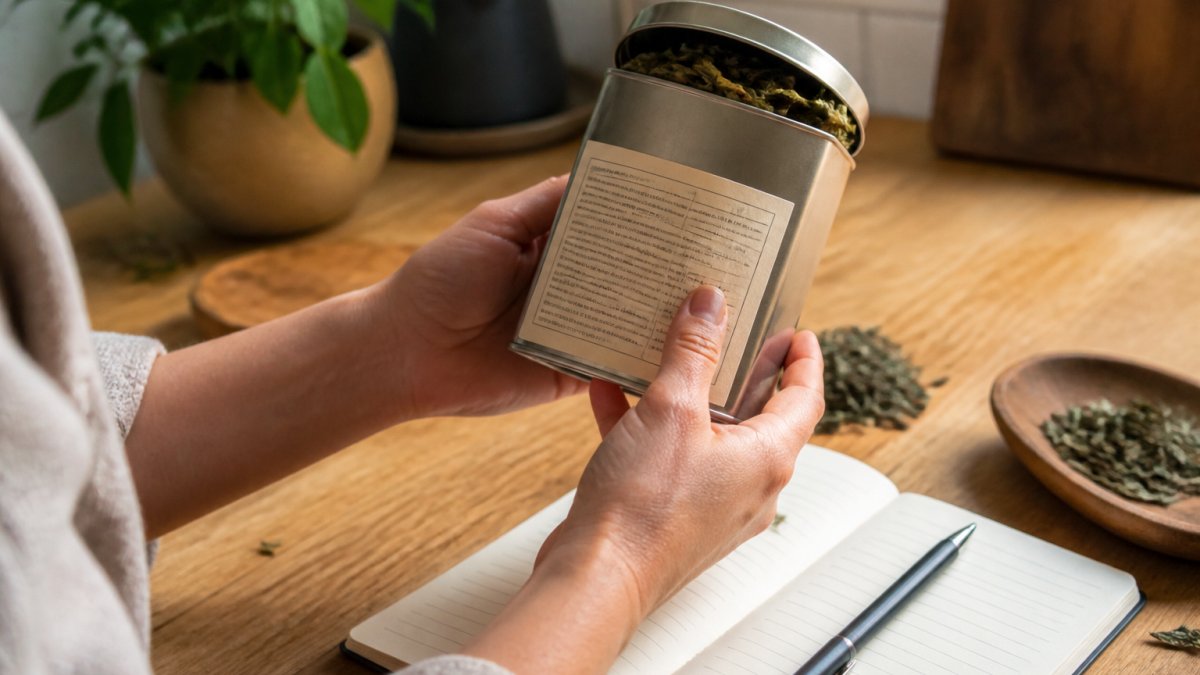
Packaging deserves a line of its own. Many conventional tea bags contain polypropylene, a plastic that does not break down. Loose-leaf tea in a recyclable tin sidesteps the issue and usually gives you better leaf grade too.
Once you have run the checklist, put it to work on a tea you can actually read the label of. Our Matcha is a single, focused product with a clear identity in the cup. If you want a blend to test your new skills on, the Moroccan Mint pairs green tea with fresh mint, and the Earl Grey lists its Ceylon base and bergamot oil openly.


Choose Your Next Cup With Oak & Origin
The tea market rewards vague language, so the burden of proof lands on you.
At Oak & Origin Coffee Co., we build our tea selection around small-batch sourcing and named origins, so you can trace what is in your cup.
Start with our Hibiscus Berry Tea for a caffeine-free, cold-brew-friendly option.
Get started with Oak & Origin Coffee Co. and make your next cup one you can actually trace.
Frequently Asked Questions
What certifications should I look for when buying tea?
Look for seals you can verify independently: Fairtrade, USDA Organic, and Rainforest Alliance are the most common on tea sold in the US. Each covers a different thing. Fairtrade addresses pricing and worker standards, USDA Organic covers farming inputs, and Rainforest Alliance covers environmental and social criteria on a broader farm level. A single tin rarely carries all three, so decide which issue matters most to you and check that specific seal on the certifier's own website rather than trusting the artwork on the package.
Does organic tea mean it is ethically sourced?
No. Organic certification speaks to how the tea was grown: banned synthetic pesticides, soil and water practices. It says nothing about whether pickers were paid fairly or housed decently. A tea can be certified organic and still fall short on tea farm worker conditions. Treat organic as one data point about environmental practice, then look separately for labor-focused certifications or a supplier code of conduct that names wages and audits.
How can I find out where a tea brand sources its leaves?
Start on the product page and look for a named region, garden, or cooperative rather than a country alone. If it only says a broad origin, email the company and ask three things: which garden or co-op, which certifier and license number, and when the last third-party audit took place. Brands serious about tea sourcing transparency answer within a few days. Vague replies about long-standing relationships are your signal to keep looking.
What is the difference between sustainable and ethical tea?
Sustainable usually refers to environmental impact: soil health, water use, biodiversity, pesticide use, and packaging. Ethical usually refers to people: fair prices, fair wages, labor practices, and working conditions. Many certifications blend the two, which is why labels get confusing. When you shop, separate the questions. Ask what happened to the land and what happened to the people who picked the leaf, then check which seal actually addresses each one.
